Author: C. L. Bolt
-
A Very Brief Response To Bahnsen Burner Concerning Conditions Of Knowledge
Unfortunately I see the recent response from Dawson Bethrick (available on his blog) as a lengthy discussion of topics rather irrelevant to the points I raised in my post that he is allegedly responding to concerning Conditions of Knowledge. I am at a loss as to why someone familiar with the topic at hand would understand my post as something other than a discussion of problems related specifically to a materialist understanding of the world.
When we speak of ‘belief in a proposition’ we usually mean ‘belief that a proposition is true’, not a belief that the proposition itself exists! …
-
A friendly chat in simple terms.
Chris: You are an unbeliever?
Unbeliever: I’ll say for argument sake that I am.
Chris: For argument sake?
Unbeliever: Yes it’s complicated. lol
Chris: How so?
Unbeliever: I’m confused. Put it that way.
Chris: I see. Would you say you believe in God?
Unbeliever: I’m open to the possibilities.
Chris: So, you attend church every other Sunday?
Unbeliever: No. I stopped going to church.
Chris: That does not sound very safe. Or open.
Unbeliever: You’re right.
Chris: So really, you live as though there is no God?
Unbeliever: I haven’t really been seeking.
Chris: So what would it take? For … -
Conditions of Knowledge
In order for you to know something, it must be true, you must believe it, and you must have some kind of warrant for it.
Believing occurs inside of you, and belief is “about” something. My computer desk cannot be about some other idea. A piece of raw meat cannot be about Hector Berlioz. However a belief can be about Hector Berlioz. “Hector Berlioz wrote thematic music” is a belief about Hector Berlioz. It would appear that desks, meat, and other such natural objects do not share this feature with beliefs (“aboutness”). It appears that beliefs are not reducible to …
-
Do we know anything at all?
If we are going to be able to think about anything at all, we have to start somewhere. Where do we start then, and why? If we do not know, then can we think anything at all (intelligibly)?
There appears to be no universal consent on any fact of existence; facts do not appear to speak for themselves, they must be interpreted, else everyone would agree and as already said they do not.
You have made mistakes before, why not again? How do you know that you are not making a mistake even now? Remember those things you felt so …
-
Snakes and Slaves
Question: “I am curious what the valid response is to someone in regards of the talking snake. The apologetic response.”
Basically we can only know that the world has regularities because God is in control of it. If God was not in control of it, or did not reveal to us that He is, then we would not be able to predict that the next snake we encounter cannot talk. (It was a serpent by the way.) So if you reject the account in Scripture you have no reason to reject a snake talking. If you accept the account in …
-
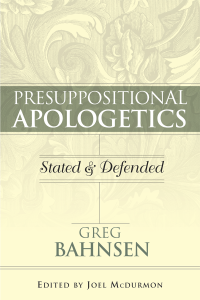
A New Book By Greg Bahnsen
No one I know has read this book yet. This is probably because most of the people I know have not realized that this book is available. Thanks to Brian Knapp for bringing this to my attention.
…
-
Why am I still a Christian? Some Observations With C.S. Lewis
“I believe in Christianity as I believe that the sun has risen: not only because I see it, but because by it I see everything else.”
This was written by C.S. Lewis. Now what in the world did he mean by this? Hopefully, this short piece will help you understand what he meant by this, if I have understood him correctly and if I am right that I can relate to what he meant by this statement.
Lewis says that he can see Christianity. By this I take him to mean that he believes in Christianity and experiences the truth …
-
From a “Sunday School” lesson…
Do not answer a fool according to his folly, Or you will also be like him. Answer a fool as his folly [deserves], That he not be wise in his own eyes. (Proverbs 26.4-5 NASB)
Do not answer a fool according to his folly, Or you will also be like him.
Every unbelieving objection to faith stems from a misunderstanding or misrepresentation of the teachings of Christianity. To illustrate this point, think of driving on the left hand side of the road. Most of you all would think that it is absurd to drive on the left hand side of …
-
Tract For Thomists
Consider the argument that “everything which begins to exist has a cause for its coming into existence, and the universe began to exist, therefore the universe has a cause for its coming into existence”. Someone would have to know everything in order to even begin to show that “everything which begins to exist has a cause for its coming into existence”. Further, the argument just assumes that the universe has a cause because everything else does. Perhaps everything which begins to exist does not have a cause because the universe does not. Aside from these difficulties is the difficulty of …
